

HUATUO Adds Huawei Ascend NPU Monitoring Support
In large-scale AI training, a single hardware failure can slow or interrupt an entire job. Minder, an NSDI 2025 paper, analyzed seven months of production data. It found that some training jobs used more than 10,000 GPUs and experienced an average of about two unexpected software or hardware failures per day. Hardware failures within a node accounted for 55.8% of all failures, and ECC errors accounted for 38.9%. Meta’s statistics from training the Llama 3 model family show that more than 66% of interruptions were related to hardware failures.
Hardware reliability is a key factor in the stable operation of large-scale AI clusters. To address this issue, PR #198, contributed by the Huawei Ascend team, has been merged into HUATUO. The change adds in-depth observability for Huawei Ascend NPUs. Through DCMI, PCIe, and HCCN, HUATUO continuously monitors device status, compute workloads, memory reliability, and communication links to help teams detect and diagnose issues during training and inference.

Support Overview
HUATUO is an open source, operating-system-level observability project initiated by Didi and incubated by the China Computer Federation (CCF). It provides kernel-level monitoring, anomaly tracing, automated diagnostics, and continuous profiling for cloud-native general-purpose computing, AI computing, and infrastructure.
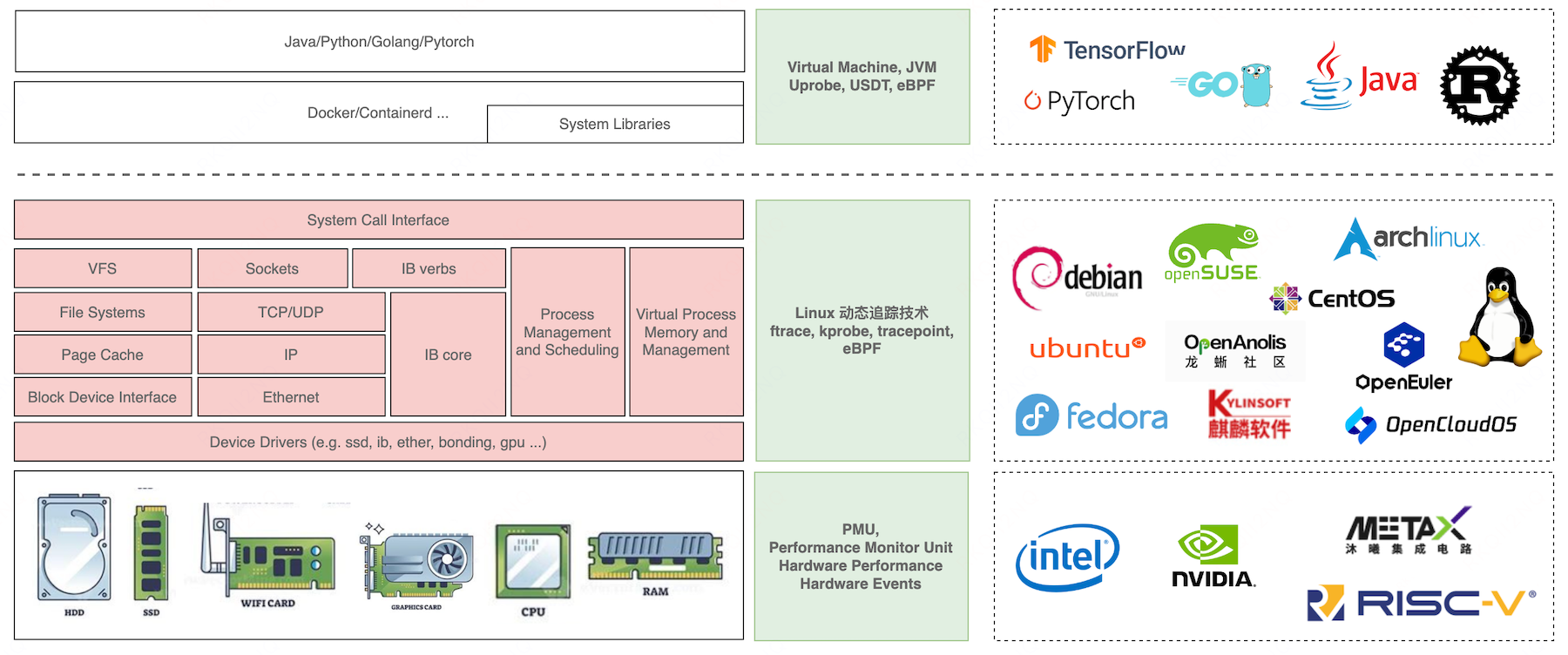
HUATUO’s Ascend NPU support covers key fault domains across devices, memory, interconnects, and communications. It helps reduce monitoring tool fragmentation, inconsistent metric definitions, and disconnected alerting systems in heterogeneous environments. It provides a unified observability interface for AI training and inference in cloud-native environments.
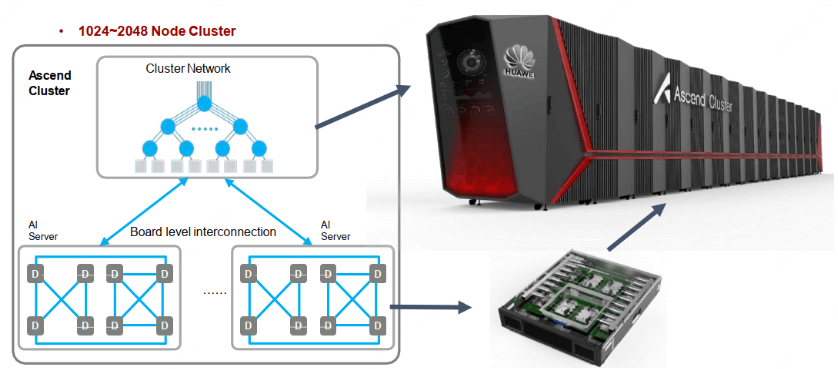
Operational Benefits
This feature converts device data from DCMI, hccn_tool, and PCIe sysfs into a consistent set of Prometheus metrics. Hardware issues can then be monitored continuously, correlated across components, and reported through automated alerts.
| Typical symptom | Correlated signals | Potential causes to investigate |
|---|---|---|
| Reduced compute performance on one NPU | Utilization, AI Core frequency, power, and temperature | Overheating, frequency throttling, or uneven workload distribution |
| Intermittent job failures | HBM single-bit and double-bit ECC errors and isolated page count | HBM reliability issues and an increasing number of bad memory pages |
| Slower multi-NPU communication | Current PCIe link speed or width below the maximum supported values | A downgraded PCIe link, slot issues, or hardware faults |
| Collective communication timeouts | HCCN link state, RoCE packet errors, retries, out-of-order packets, and CNPs | Congestion, packet loss, or link faults |
| Cross-node performance fluctuations | Optical module temperature, voltage, transmit and receive power, LOS, and SNR | Degradation of an optical module or optical link |
New Observability Capabilities
With the Huawei Ascend team’s contribution, HUATUO can collect key Ascend NPU metrics through DCMI, PCIe, and HCCN.
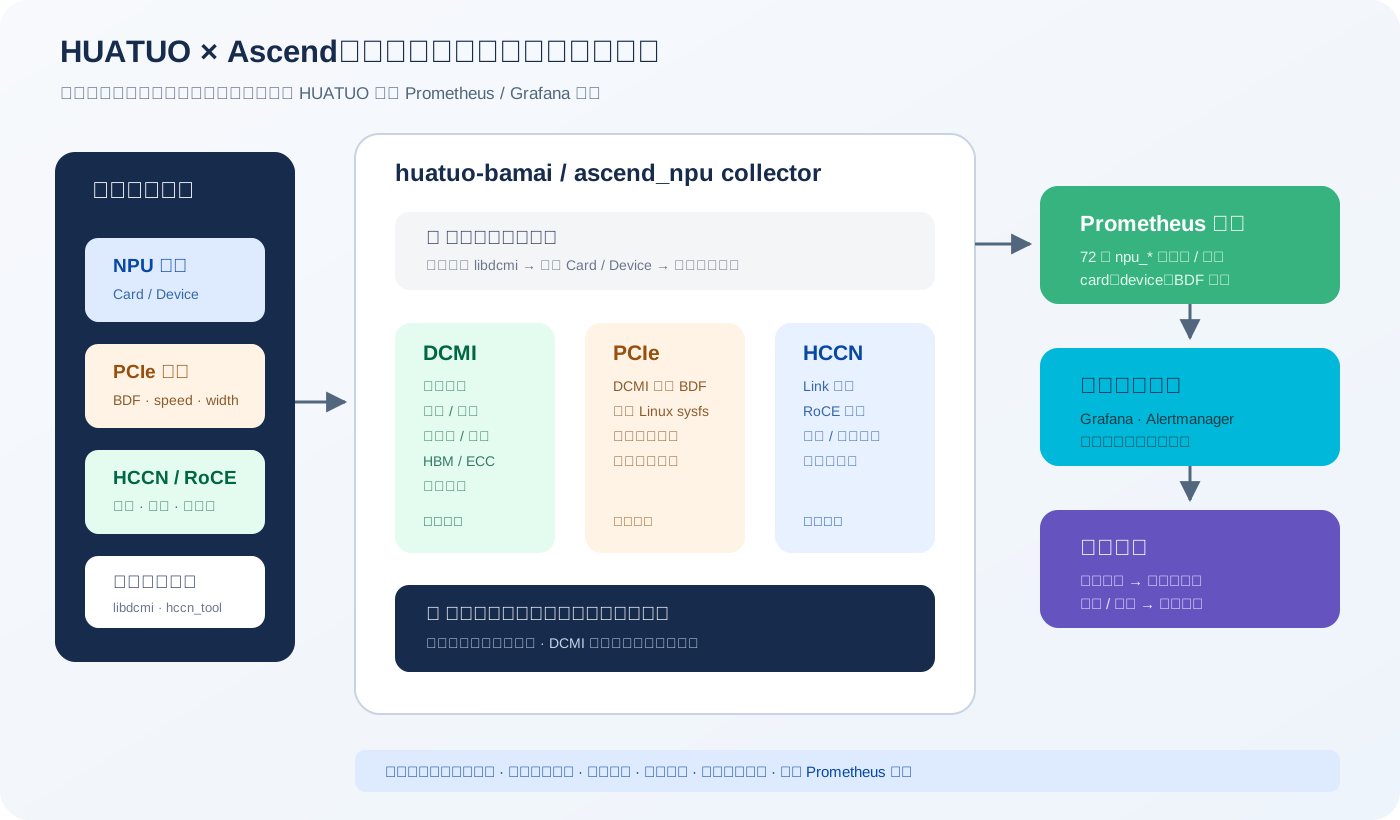
At startup, the DCMI collector dynamically loads /usr/local/dcmi/libdcmi.so, the default path on Linux. After loading the library, it registers the following core interfaces and manages the collection lifecycle through a common initialization, shutdown, and retry mechanism:
|
|
After enabling the collectors, you can query the following data in HUATUO:
| Collection path | Monitoring scope | Key metrics |
|---|---|---|
| DCMI | Device status and compute workload | Health, power, temperature, voltage, utilization, and clock frequency |
| DCMI | HBM status and reliability | Capacity, usage, temperature, bandwidth utilization, ECC errors, and isolated page count |
| PCIe | Host-side links | Maximum and current link speed, and maximum and current link width |
| HCCN | Inter-NPU networking and RoCE communication | Link state, transmit and receive rates, packet errors, retries, out-of-order packets, CNPs, and optical module information |
Configuration and Deployment
Enable Data Collection
ascend_npu is included in the global BlackList by default. Before enabling the collector, remove it from the blacklist and enable the required collection capabilities:
|
|
You can configure EnableDCMI, EnablePCIe, and EnableHCCN independently based on the device model, driver capabilities, and deployment environment.
Container Deployment
When running HUATUO in a container, mount the Ascend driver and DCMI library from the host into the container. The following command is an example; adjust the paths for your installation:
|
|
Conclusion
Huawei Ascend NPU support extends HUATUO’s observability coverage for AI infrastructure. It also provides a unified interface for fault analysis in heterogeneous computing environments.
Moving from reactive troubleshooting to monitoring throughout the hardware lifecycle, continuous alerting, and root cause analysis helps improve AI cluster reliability. HUATUO will continue to refine its metric documentation, alert threshold recommendations, and troubleshooting procedures for common scenarios to help teams use these capabilities in production.
Related Links
- HUATUO GitHub: https://github.com/ccfos/huatuo
- Ascend NPU support PR: https://github.com/ccfos/huatuo/pull/198
- Official announcement (Chinese): https://huatuo.tech/zh/events/2026-07-29-huawei-ascend-npu-monitoring/
- NSDI 2025 Minder paper: https://www.usenix.org/conference/nsdi25/presentation/deng
- Meta’s AI hardware reliability practices: https://engineering.fb.com/2025/07/22/data-infrastructure/how-meta-keeps-its-ai-hardware-reliable/
- Huawei Ascend overview: https://e.huawei.com/cn/products/computing/ascend
- DCMI / npu-smi / hccn_tool: https://www.hiascend.com/document/detail/zh/Atlas%20200I%20A2/260RC1/re/npu/npusmi_135.html