

RDMA: Memory Window
This blog post is part of a series of foundational technical research articles on AI Infrastructure.
Concept
Basic Concept: A Memory Window (MW) is a type of RDMA resource requested by the user that enables a remote node to access a local memory region. (For this reason, an MW possesses only an R_KEY and has no L_KEY.) Each MW is bound to an already registered Memory Region (MR). Compared to an MR, an MW provides more flexible control over remote access permissions. An MW can be roughly understood as a subset of an MR. A single MR can have multiple MWs carved out of it, and each MW can have its own permission set configured. The relationship is illustrated in the following network diagram:
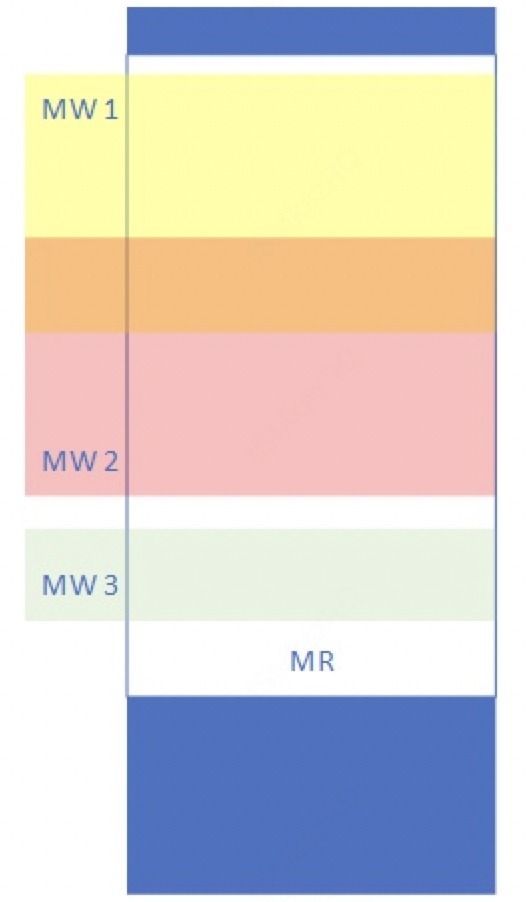
MR/MW Permission Relationship: When binding a Memory Window, a Consumer can request any combination of remote access rights for the Window. However, if the associated Region does not have local write access enabled and the Consumer requests remote write or remote atomic access for the Window, the Channel Interface must return an error either at bind time or access time.
Use Cases:
- To grant and revoke remote access rights to a registered region dynamically, thereby reducing performance penalties.
- To grant different remote access rights within the same registered memory region to different remote agents.
Implementation
User-space Implementation: libibverbs API:
|
|
Parameters and Return Values:
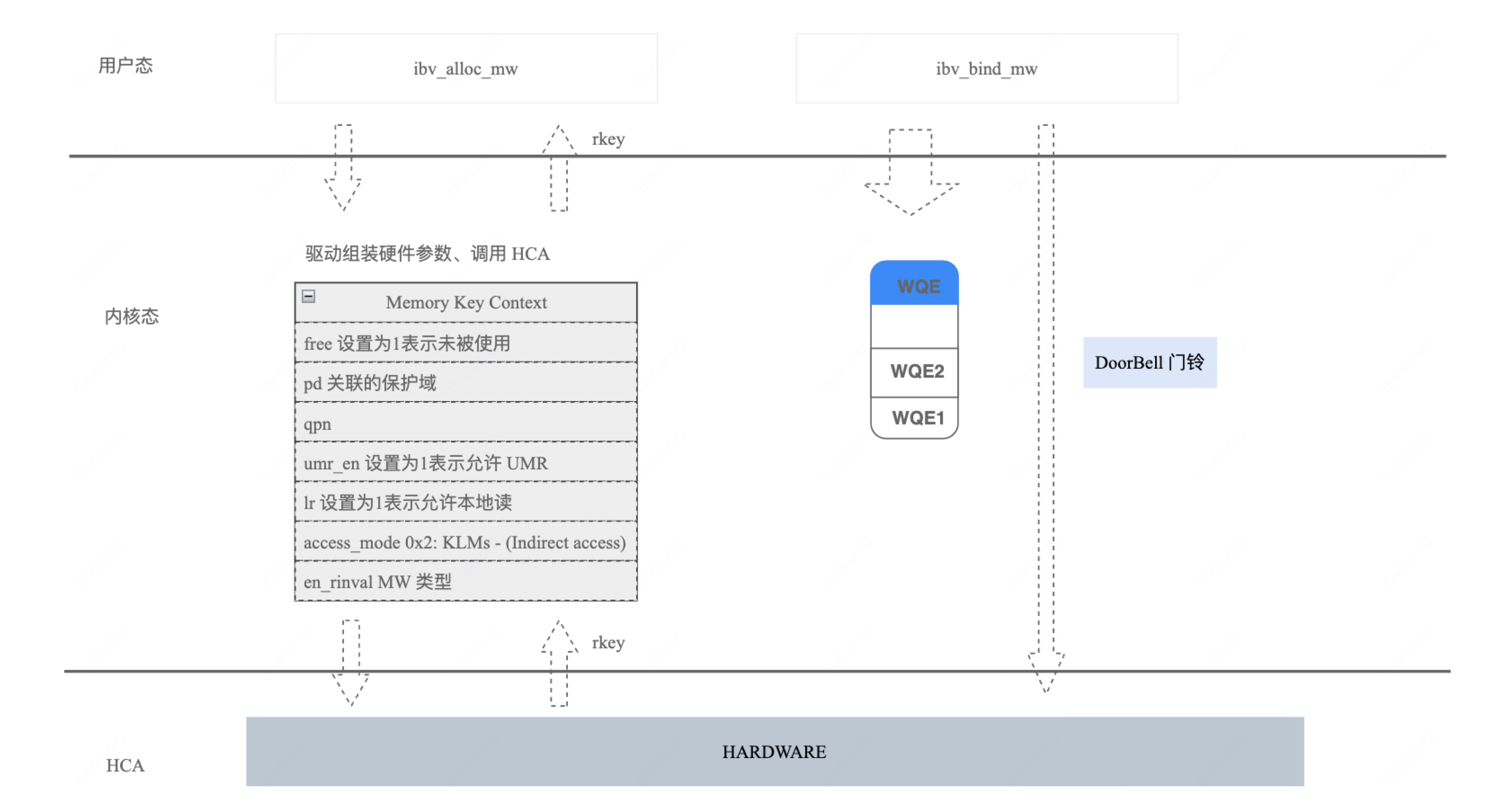
ibv_mw_type: ForIBV_MW_TYPE_1, the MW can only be bound to an MR via theibv_bind_mwmethod. ForIBV_MW_TYPE_2, binding occurs viaibv_post_send.rkey: The Remote Key generated by the HCA. The kernel driver implementation is straightforward: it assembles the parameters and dispatches the command to the hardware.
Kernel Implementation:
mlx5_ib_alloc_mw constructs the MKey Context and submits it to the HCA.
|
|
Memory Window Binding, 1:
|
|
mw_access_flags:
IBV_ACCESS_REMOTE_WRITEIBV_ACCESS_REMOTE_READIBV_ACCESS_REMOTE_ATOMICIBV_ACCESS_ZERO_BASED
|
|
Memory Window Binding, 2: A more flexible approach involves assembling the WQE manually and submitting the request via ibv_post_send.
Observations
- Must the MW
addrfall within the MR’s range? In RDMA programming, a registered Memory Window (MW) must be bound within an already registered Memory Region (MR). It cannot exist independently, nor can it extend beyond the boundaries of the MR. The MR is the fundamental unit for memory registration and address translation (Virtual Address → Physical Address). The RDMA NIC hardware relies on the MR to validate and access memory. The MW itself performs no memory registration; its function is solely to refine access control and scope restrictions on top of the MR. This mechanism is primarily used for the dynamic granting and revocation of remote access permissions. Furthermore, frequent MR operations incur significant performance overhead, whereas MW operations are relatively lightweight.
HUATUO is an operating system observability project open-sourced by DiDi and incubated under the China Computer Federation (CCF).